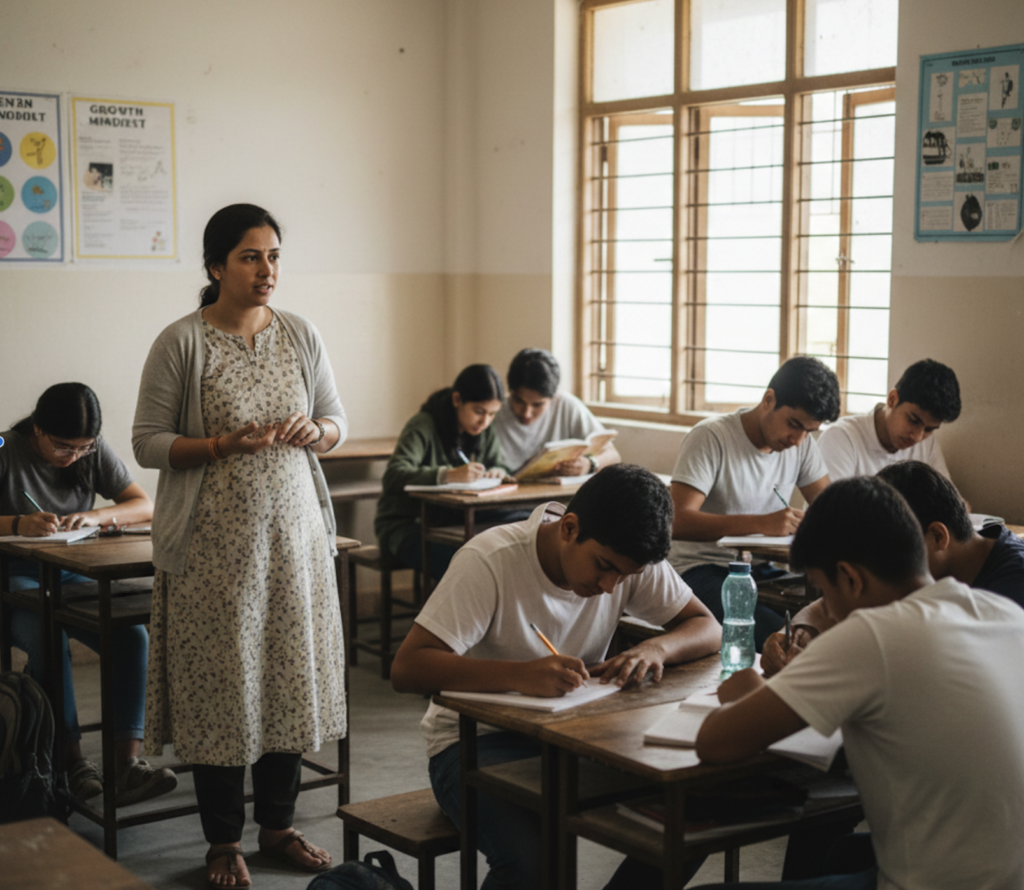
If you look at a typical classroom, like the one in the image above, everything appears normal. Students are seated at their desks, writing quietly. A teacher stands nearby, guiding them through the lesson. From the outside, it looks like learning is happening exactly the way it should. But beneath this calm surface, many teenagers are fighting battles that textbooks do not talk about.
Friendship conflicts, first love, rejection, comparison, ego clashes, family pressure, identity confusion, and silent anxiety often sit right beside notebooks and pens. These struggles rarely show up in exam papers, yet they deeply affect how students think, behave, and learn.
Teenage Years: More Than Just Academics
Adolescence is one of the most emotionally intense phases of life. Teenagers are not just students — they are human beings trying to understand themselves.
Some common challenges students face inside classrooms include:
- Friendship breakups and group exclusion
- First experiences of love, attraction, and rejection
- Ego clashes, jealousy, and comparison
- Pressure to perform academically and socially
- Confusion about identity, self-worth, and belonging
- Difficulty managing emotions like anger, sadness, or fear
Most students do not talk about these openly. Instead, emotions come out as:
- Lack of focus
- Sudden drop in academic performance
- Irritability or withdrawal
- Behavioural issues
- Silence and emotional shutdown
To a teacher, this may look like “lack of discipline” or “lack of interest.”
In reality, it is often emotional overload.
Why Teachers Cannot Solve These Problems Alone
Teachers play an extremely important role in a child’s life. They educate, guide, discipline, and inspire. However, teachers are trained to teach subjects — not to decode complex emotional and psychological patterns. This is not a failure of teachers. It is a limitation of role and training.
Teachers:
- Manage large classrooms
- Follow academic timelines
- Handle curriculum pressure
- Are not trained in clinical psychology or emotional assessment
Expecting teachers to fully resolve deep emotional issues like heartbreak, anxiety, trauma, or identity conflict is unfair — both to teachers and students.
Just as a teacher teaches mathematics and not medicine, emotional and behavioural struggles require trained mental health professionals.
Why Counsellors Are Essential in Schools
They are equipped to:
- Understand emotional patterns beneath behaviour
- Identify early signs of anxiety, depression, or emotional distress
- Provide a safe, non-judgmental space for students
- Help students process friendship issues, love, rejection, and self-esteem
- Teach emotional regulation and coping skills
- Work ethically and confidentially
Counsellors do not replace teachers.They support teachers by addressing what teachers are not trained to handle. When emotional struggles are addressed professionally, students return to classrooms more focused, calmer, and emotionally balanced.
What the Classroom Image Really Shows
In the image, students appear engaged in writing and learning. But every student carries an invisible emotional story. One may be dealing with a friendship fallout.Another may be confused about romantic feelings.
Another may be struggling with self-worth or family pressure.
A counsellor helps bring these hidden stories to light — safely, professionally, and
constructively. Mental health support does not disrupt learning. It protects learning.